Bayesian Inference Under Spatial-Temporal Misalignment
spStackCOS implements Bayesian predictive stacking for hierarchical regression of spatially-temporally misaligned data. It develops a Bayesian hierarchical modeling framework to analyze spatially-temporally misaligned exposure and health outcome data, using predictive stacking to optimally combine multiple spatial-temporal predictive models while avoiding iterative estimation algorithms such as Markov chain Monte Carlo. See (Pan & Banerjee, 2026) for details.
The following functions fit a Bayesian spatial-temporal linear model and generate samples from the posterior predictive distribution at a spatial-temporal resolution different from what the data is observed at:
spLMexactCOS(): spatial-temporal linear model for misaligned data with fixed values of process parameters
sptBlockPredictTimeAgg(): spatial-temporal linear model for temporally aggregated misaligned data
References
2026
Envcs
Bayesian Inference for Spatially-Temporally Misaligned Data Using Predictive Stacking
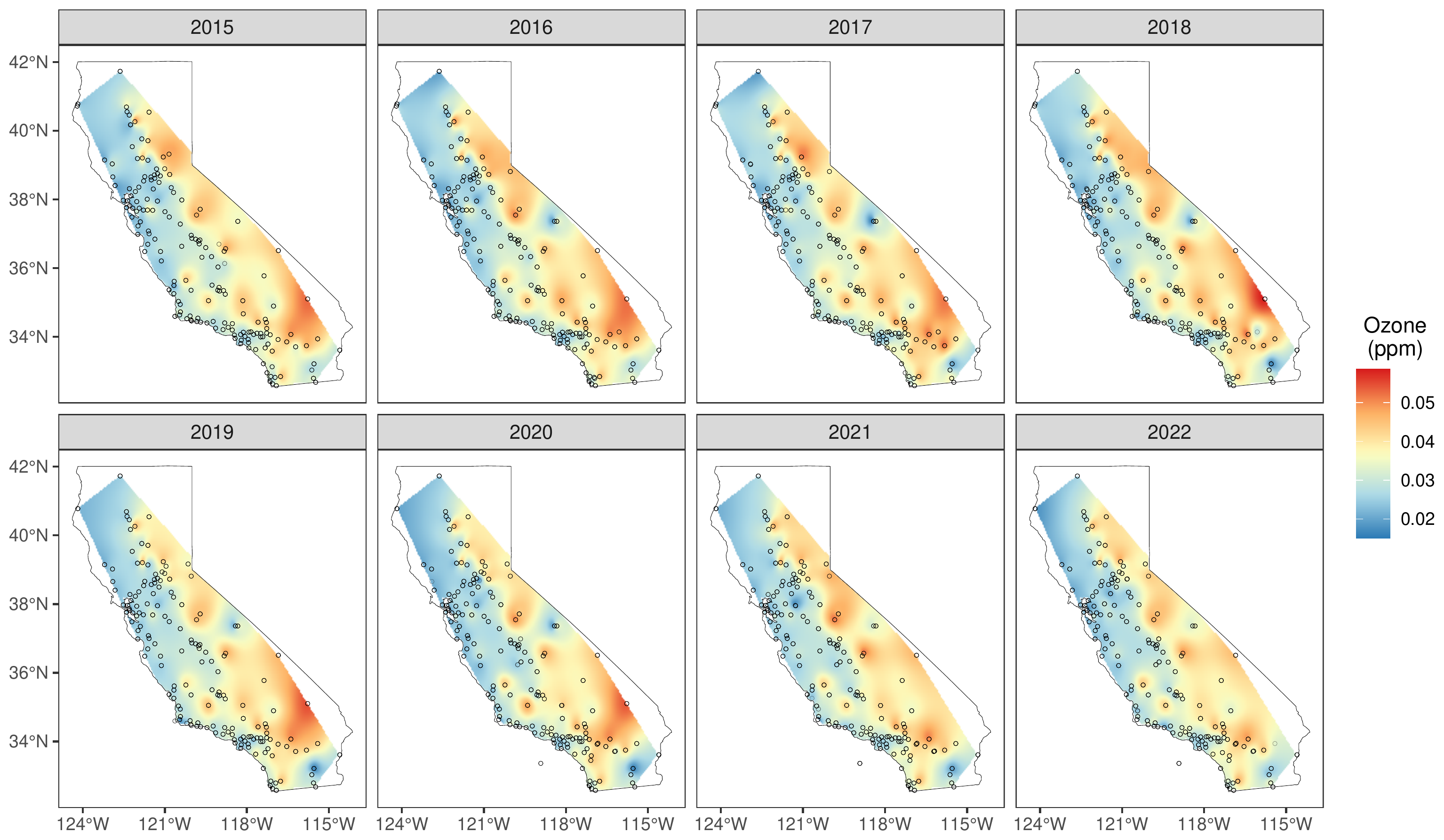
Air pollution remains a major environmental risk factor that is often associated with adverse health outcomes. However, quantifying and evaluating its effects on human health is challenging due to the complex nature of exposure data. This article develops a Bayesian hierarchical model to analyze spatially-temporally misaligned exposure and health outcome data. We introduce Bayesian predictive stacking, which optimally combines multiple predictive spatial-temporal models and avoids iterative estimation algorithms such as Markov chain Monte Carlo. We apply our proposed method to study the effects of ozone on asthma in the state of California.
@article{pan2026_envcs,title={Bayesian Inference for Spatially-Temporally Misaligned Data Using Predictive Stacking},author={Pan, Soumyakanti and Banerjee, Sudipto},journal={Environmetrics},volume={37},number={2},pages={e70072},year={2026},doi={10.1002/env.70072},show={true},}